
The Spiral: Six Attempts to Notice While the System Keeps Running 1
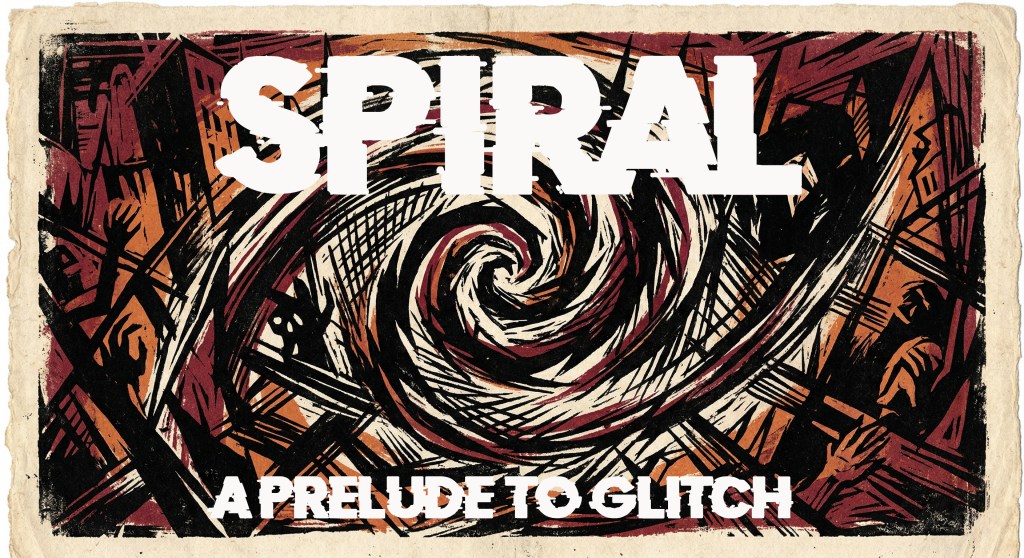
I. HOW DIGITAL ERRORS ECHO ANALOGUE HAUNTINGS
(in which the machine coughs up its ghosts and pretends it meant to do that)
There’s something charmingly pathetic about a digital error. A corrupted JPEG, a frozen frame, a little square of pixelated vomit blooming across an otherwise obedient screen. It’s the closest a computer gets to stuttering, a moment where the machine forgets its lines and looks directly at you, embarrassed. We pretend it’s a malfunction, but really it’s a confession. The glitch is the digital world’s version of a Victorian ghost: an unintended return, a flicker of the past intruding on the present, a reminder that the system is not as seamless as it pretends.
People like to imagine that analogue hauntings were somehow more “authentic.” The creak of a floorboard, the hiss of tape, the way old film stock seems to remember every hand that touched it. But digital media has its own ghosts, they’re just cleaner, sharper, and more existentially confused. A scratched vinyl record loops because something physically gouged it. A looping MP3 does so because the universe hiccupped.
One is a wound; the other is a glitch.
Both are hauntings.
The digital ghost is a creature of repetition.
It doesn’t moan in the attic; it manifests as a buffering wheel that spins like a séance table. It doesn’t slam doors; it resurrects deleted files you swore you erased. It doesn’t whisper your name; it autocompletes your search bar with things you never typed but definitely thought. The machine knows you better than you know yourself, which is its own kind of haunting.
And then there’s the uncanny nostalgia of digital decay. Analogue degradation is warm, fuzzy, sepia-toned. Digital degradation is cold, clinical, and strangely intimate. A corrupted video file doesn’t fade — it fractures. It reveals the bones of the codec, the skeleton of the compression algorithm. It shows you the grid beneath the image, the way a ghost might show you the ribs beneath its translucent skin. The glitch is the system’s unconscious erupting into view.
We pretend glitches are errors, but they’re really messages. Not intentional ones, that would be too easy, but messages in the sense that dreams are messages. They reveal the structure of the world by failing to uphold it. A glitch is a reminder that the digital realm is not infinite, not perfect, not frictionless. It is a haunted house built from code, and every now and then the walls flicker to remind you that you are not alone.
If analogue hauntings were about the persistence of the past, digital hauntings are about the instability of the present. The glitch doesn’t say “remember me.” It says, “nothing is stable.” It says, “the system is pretending.” It says, “you are living inside a machine that is trying very hard not to fall apart.”
And honestly?
Same.
Recent Comments
 | crabmansmith on Love Death and the Crucial Thr… |
 | Will on Love Death and the Crucial Thr… |
| crabmansmith on Love Death and the Crucial Thr… |
 | Mark S on Is this thing on? |
| Will on Guya – Page 10 |
 Will Vigar
Recent Comments