
Haunted When The Minutes Drag
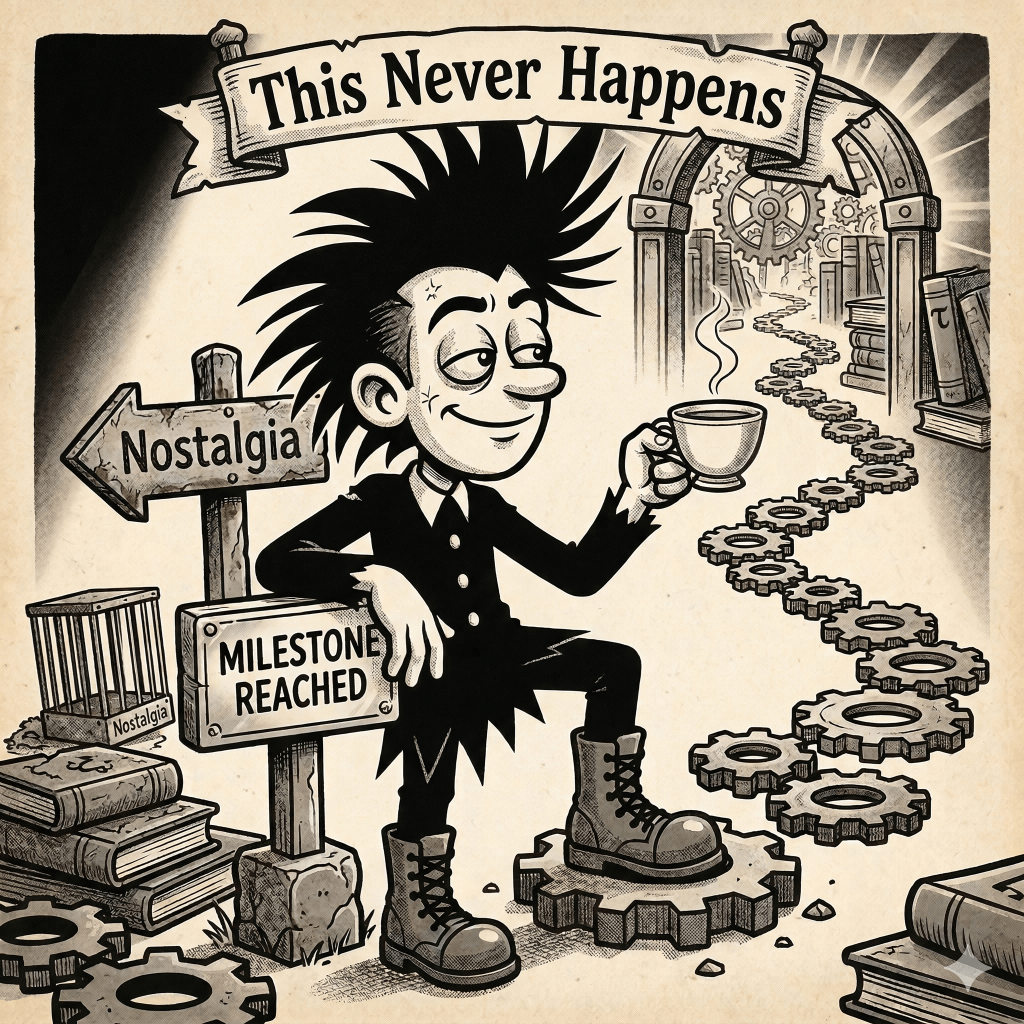
3. Living Without A Future Tense
There are periods when the future doesn’t frighten you. You await, eager, excited and it simply fails to turn up.
The future, to the agoraphobic, is like being stood up. Dates come; dates go.
You can spot the signs linguistically. “When” quietly becomes “if”. Plans acquire footnotes. Anticipation thins out. The future tense starts to feel speculative, like a grammatical indulgence you no longer quite trust.
This isn’t despair in the operatic sense. It’s subtler than that.
Life continues, but without forward momentum. Days organise themselves around maintenance rather than development. The goal is not progress; it’s containment.
We’re taught that the future waits patiently for us, but this is optimism masquerading as fact. The future has to be generated. It relies on expectation. When expectation collapses, the future doesn’t end, it becomes spectral. Present enough to exert pressure, absent enough to be unreachable.
This is where hauntology stops being a cultural buzzword and starts feeling painfully accurate. The future that never arrives doesn’t disappear. It lingers. It leaves residue. You live in relation to something that was promised but indefinitely postponed.
The past responds by becoming over-represented. Not because it was better, but because it’s available. It fills the space the future used to occupy. Not nostalgically, necessarily, just insistently.
We tend to frame this as rumination, melancholy, failure to move on. Sometimes that’s true. Sometimes it’s just what happens when temporal infrastructure collapses. When nothing new arrives to reorder what already exists.
The usual response is urgency.
Push forward.
Reengage.
Restore momentum.
This often makes things worse. It imposes a narrative demand that the situation cannot meet.
What happens if we treat suspended futurity as a condition rather than a catastrophe? Not something to celebrate, but something to understand.
I don’t have a solution.
I’m suspicious of solutions, in the same way I’m suspicious of ‘happy endings.’
I’m interested in what becomes visible when the future loosens its grip. What kinds of attention are possible when “what comes next” stops dominating the room.
Living without a future tense is not sustainable. Neither is pretending the future is equally accessible to everyone.
Somewhere between those truths is a space worth examining.
Recent Comments
 | crabmansmith on Love Death and the Crucial Thr… |
 | Will on Love Death and the Crucial Thr… |
| crabmansmith on Love Death and the Crucial Thr… |
 | Mark S on Is this thing on? |
| Will on Guya – Page 10 |
 Will Vigar
Recent Comments