
Ardnamurchan
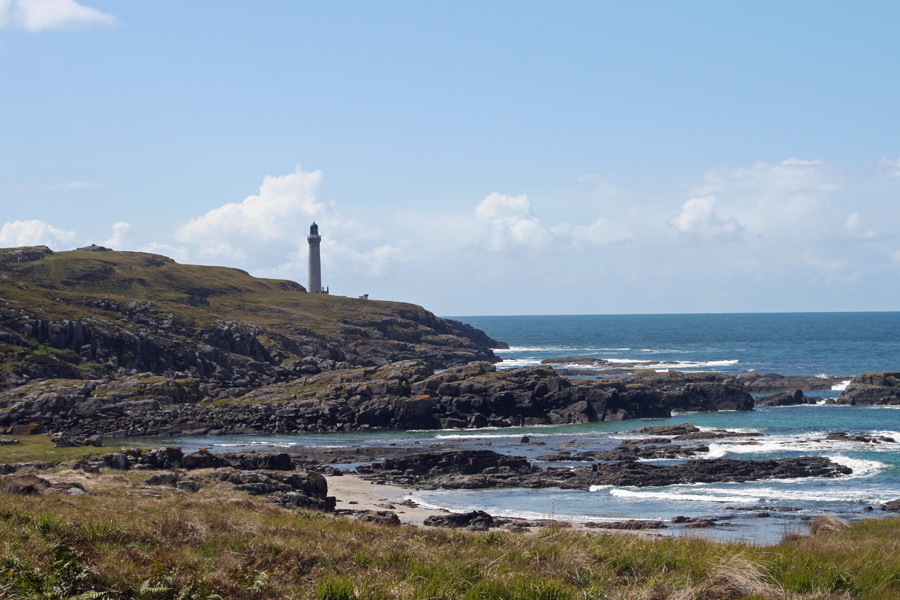
i -1968
When I was four years old, we went on holiday with to the exotic sounding Ardnamurchan Point on the west coast of Scotland.
I remember leaving home in the early evening and camping by a loch overnight. My brother tried to scare me, tried to convince me that we were camped by Loch Ness and that the fabled monster would eat us while we slept. A few days previously, I had heard my parents planning the journey, saying that stopping at Loch Lomond would be the best course of action, so my brother’s stories were ignored.
When we reached the loch, close to midnight, owing to poor weather, we ate an unpleasant campfire meal of tomato soup; its strange texture turned out to be swarms of midges that had recently met their hot vegetable-based death.
The following morning, rather than blinding rain, a thick fog had descended. The journey to Ardnamurchan seemed to take forever not least because of the inevitable:
‘I spy with my little eye, something beginning with F.’
‘Fog.’
‘Yes, your turn.’
‘I spy with my little eye, something beginning with F.’
Ad nauseum.
After what seemed like a lifetime, we heard a thick, guttural roar. Stories of monsters again intended to frighten me fell on deaf ears as I had already seen the rotating light of the Ardnamurchan lighthouse, desperately punching through the dank smoch.
We had recently seen ‘The Beast from 20000 Fathoms’ – no longer an X-rated horror but broadcast in the afternoon to keep the children on their summer holidays from school entertained. I remembered the beast calling mournfully to a lighthouse foghorn, mistaking it for the mating call of another of its species. We were a long way from Loch Ness, but I wished I could see the conversation between foghorn and Nessie. Nessie clamours for attention, the lighthouse saying ‘notice me’ with its winking eye and ‘keep away’ with the foghorn scream. Visual and audible. Mixed Signals. Having seen my brother flirting with the eldest daughter of our co-campers, I feared the union of Nessie and the lighthouse was doomed.
When we finally reached the campsite, the fog at was so thick, that our parents banned us from leaving the tent once we had secured the guide ropes and sorted the sleeping arrangements. There was a real danger of vanishing into the tracing paper air. So, we were trapped in a leaky tent with a dying transistor radio; the World Service slowly crackling and fading out gave a solemn, almost apocalyptic feel to this first night. There was not enough battery power in the torches to read or play games, and a hyperactive brother – born to irritate – was no fun at all.
This wasn’t the seaside holiday we were promised.
On that first night my dad turned the transistor radio on, flipping between radio two and the world service. For the first time, I hear the sonorous intonations of a nautical prayer:
‘Humber, Thames, south-east veering south-west four or five occasionally six later. Thundery Showers. Moderate or good, occasionally poor.’
At the time, it meant nothing to me, but I was intrigued enough to ask what the man on the radio was saying.
‘It’s the shipping forecast,’ he said, but would be drawn no further.
The following morning, the early sun beat down on our blue canvas tent, making it steam and smell unpleasantly like a wet dog. Ironic, as our dog had managed to stay warm and dry by stealing space in my sleeping bag.
The tent was enormous – tall enough for my dad to stand up straight in. We unzipped the semi-opaque plastic door, pulled away the canvas and emerged from the tent. We groaned, stiff from the lack of movement and the cold bite of the fog. We stretched and gazed in awe at navy and lilac mountains, piercing the cobalt sky. Breath taken, we ate a hearty – midgeless – breakfast and walked from the campsite to the top of the ridge that separated from the as-yet-unseen beach. As we hit the crest of the hill, the smell of ozone and iodine hit me with an indelible force. I only have to close my eyes and wish to be filled with the scent of the sea.
Nothing that followed in the next two weeks – chasing sand eels, collecting winkles for tea, angry sea anemones squirting seawater at us at low tide, the alien landscape of a hundred beached jellyfish, deposited at low tide and returned to the sea at high; the unhinged, unstoppable charge down the heathered bank where gravity and poor coordination collided in a Catherine Wheel of liquid limbs – was quite as powerful and as beautiful as the sound and scent of the sea.
That scent, that moment, was a gateway to another world.
Ten years later, the memories of Ardnamurchan are ones that I still recall when I need to calm down, or need cheering up, and they, relax me enough to sleep. It has become a meditative focus.
3 – 1974
I’m in bed, hiding under the blankets. It is late, almost midnight, and I’m listening to the transistor radio with a white mono earphone to hide from my parents that I am still awake. Radio Luxemburg is churning out the latest hits, but as the signal fades, I know it is time to switch over to the long-wave channel.
‘Sailing By,’ the Shipping Forecast’s theme music, fades in and after it lulls me into deeper relaxation, a voice as thick and sweet as my mother’s plum jam tells me of far-flung sailors on the high seas and the weather conditions that might help or hinder them.
In my now semi-asleep state, I hear the announcer intone his spell, and I cannot work out whether he is reporting the conditions or making a decree: a weather wizard casting his spell over the seas, instructing Manannán, Nodens, Njord and the nine daughters of Aegir, Llŷr, and countless others to exact his blessing or his curse.
I imagine sailors aboard their ships, waiting for the proclamations that determine their course of action for the next few hours, at least. Even with modern equipment, far more accurate than a mere weather forecast, they await the soporific intonations while breathing a shallow prayer to St. Nicholas. The shipping forecast is litany, a throwback to a more superstitious age, a denial of technology, even on the technological wonders of the modern fleet.
Remembered ozone, brine and iodine fill my nostrils, and I plunge into sleep. I dream that the sea areas are states in a ghost continent in negative space. In Rockall, the lonely King sits atop his granite stack and laments the loss of his people. Years later, his erstwhile son exacts a coup over the whimsical people of Finisterre, devoted to song and dance and Technicolor musicals. He changes the name of his principality to Fitzroy, the son of the king. The prophetic name Finisterre truly becoming the end of their world.
Meanwhile, the warlike tribes of Trafalgar look on, seething with jealousy, planning their invasions. The Forties live in the perpetual euphoria of post-war optimism, and the last of the undersea Egyptian Kings, tormented and exiled, makes a new home in the Faroe Isles.
I’ve often thought of writing a fantasy novel, the kind with a hand drawn map in the frontispiece. The Great Britannian Lake and its surroundings would make for a terrific map. It’s a shame I don’t like that sort of fantasy novel.
4 – 2022
I have long planned to return to Ardnamurchan and as lockdown eases, the reality of returning becomes stronger. We plan a tour of the western coast of Scotland, taking in islands, mountains and, of course, Ardnamurchan lighthouse, now automated with the nearby building converted into a visitor centre and café.
Our eight-day itinerary is checked and double checked for driving times, ferry times and opening times of attractions. Our usual plan is to travel in the off-season, partly for the sake of cost and partly because of social phobia associated with agoraphobia.
I love the roar of the sea, gulls perforating the white noise with gladiate screeches. I love its wildness, its uncompromising intensity. Its purity. Just me, lost in the natural world, my back to the world I find so difficult to navigate.
People complicate the sense of communion I have with the sea, so avoiding the beach on-season is an imperative. It’s become a standing joke when walking the wintery shores; “I bet it’s hell in summer.’
With our plans in place, we set about making it a reality only to find that with the rise of staycations, all hotels in the region are booked solid, even during the off-season. Nothing where we want to be is available for several months.
5 – 2025
We finally find time to rebook the holiday we missed out on in 2022. This time, there are no overbooked hotels. We find the right rooms at the right prices, in the right towns. The day before we are due to go, we receive a weather warning. All trains north of Preston are cancelled for at least two days thanks to the incursion of Storm Eowyn into the west coast of Scotland.
I started writing this as a way of ‘chasing ghosts.’ Reconciling my love of the sea and the things that have contributed to my personal mythology. It seems oddly appropriate that the return to Ardnamurchan has been thwarted, again, remaining a ghostly presence in my own saga.
Lullaby – The Shipping Forecast
2 comments on “Ardnamurchan”
Leave a reply to crabmansmith Cancel reply
Recent Comments
 | crabmansmith on Love Death and the Crucial Thr… |
 | Will on Love Death and the Crucial Thr… |
| crabmansmith on Love Death and the Crucial Thr… |
 | Mark S on Is this thing on? |
| Will on Guya – Page 10 |
Recent Comments
| crabmansmith on Love Death and the Crucial Thr… |
| Will on Love Death and the Crucial Thr… |
| crabmansmith on Love Death and the Crucial Thr… |
| Mark S on Is this thing on? |
| Will on Guya – Page 10 |
 Will Vigar
lovely writing
LikeLike
lovely writing
LikeLike