
The Long Return
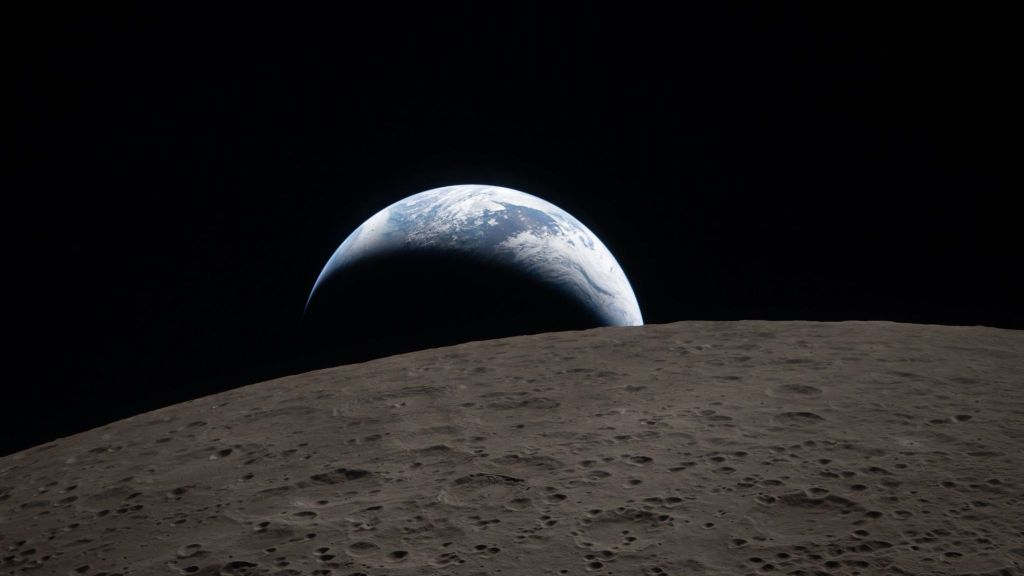
I remember when the Moon was new territory.
Newly acquired. For the first time, the moon was ours. Not just a wan light in the sky. Ours.
The broadcasts said, ‘we’re going back,’ although nobody really thought of it as back. Back implies return, repetition.
This was progress.
Progress is not a return; it is moving forward.
This was a dress rehearsal for life lived slightly above the ground.
They spoke of lunar bases with the confidence of people discussing ring roads.
Functional.
Inevitable.
Mars entered the conversation and holidays on the red planet became a distinct possibility.
The year 2000 was named often.
It carried the weight of a full stop.
After that, everything would be different. We would commute between planets the way we’d once learned to commute between decades.
Eagerly, I waited.
Waiting, it turns out, is an underrated form of labour. It requires maintenance. Faith has to be kept aired, occasionally rearranged, like an old jumper you no longer like but aren’t ready to throw out. The Moon landings became something you rewatched, then something you remembered watching, then something you remembered remembering.
The footage aged into itself, got comfortably with itself and took on the demeanour of a grumpy elder relative, being forced into the front room for Christmas. ‘Look, he’s still here.’
The future quietly excused itself from the room and time went odd on us.
So odd, in fact, that some people decided we must never have gone at all.
It’s an impressive manoeuvre, intellectually speaking: arrive so late to the future that you begin bulldozing the past. Moon‑landing deniers, flat‑earthers, figures who look at a half‑century of engineering, telemetry, burned fuel and exhausted bodies only to conclude that the real impossibility was not reaching the Moon, but agreeing on it.
I try not to be annoyed.
Annoyance implies urgency, and I’m no longer in a hurry.
Mostly I find it faintly comic.
History only starts getting called a hoax once it feels too ambitious for the present to have produced.
Still, they don’t linger long in my thoughts. Gravity, after all, is stubbornly unimpressed by podcasts. Rockets continue to behave like rockets. The Moon hasn’t withdrawn its consent just because the internet had a meeting.
Artemis arrives, not like a breakthrough but like a returning theme you’d assumed the composer had abandoned.
Same key, different tempo.
The ship looks cleaner than Apollo, sleeker, earnestly contemporary, but it is unmistakably haunted by its predecessor. You can see it in the curves; in the way the capsule seems to apologise slightly for existing again. History does not repeat, but it does clear its throat.
I feel the old thrill. I’m surprised to find.
It comes back easily, like a tune you thought you’d forgotten but which turns out to have been lodged safely somewhere behind your teeth all along. Launch footage still works on me. Fire, intention, an argument with gravity that briefly appears winnable. I catch myself leaning forward, as if participation were still an option.
It isn’t, of course.
That’s where the sadness warms rather than bites.
Artemis does not make me angry.
Its less disappointing than Kohouetks fizzle.
Its less disappointing than Shoemaker-Levy 9 not detonating Jupiter.
It makes me gently ridiculous.
I picture myself on the Moon and immediately want a handrail. I imagine Mars and start wondering about knees, circulation, the etiquette of falling over very slowly in low gravity. The future has arrived wearing ‘fuck me’ shoes that all the Viagra in the world could not negotiate.
And yet, how strange that it comes now.
After all this time.
After all the talk of endings, saturation, exhaustion. After we learned to lower our expectations until they would fit inside a pocket.
Artemis feels less like a promise than an apology. The kind you accept even if it doesn’t quite cover the years spent adjusting your hope to keep it from spoiling the room. Not “look what you’ll get,” but “we didn’t forget.”
There is something faintly impish in the timing. The universe, it turns out, has manners and a sense of humour. The great adventure resumes just as the generation that first packed its imaginary bags discovers it no longer qualifies for the trip. We don’t get to go, but we do get to see that it wasn’t complete nonsense to want to. We didn’t dream the impossible.
That matters more than I would have expected.
Hauntology isn’t only about loss. It’s about delayed arrivals, futures that knock politely long after you’ve stopped setting the table. Artemis drags the old tomorrow into the present, scuffed and slightly embarrassed, but undeniable. Proof that history didn’t simply stall; it wandered, misplaced its notes, and has now returned to the stage hoping we won’t make a fuss about the gap.
I watch the spacecraft arc away as something I once carried lightly finally acquires weight and velocity. A dream departs even as it proves it was real all along.
Not closure. That’s too neat, and as anyone who knows me knows, closure is just a way of forgetting with purpose.
It’s something closer to companionship.
The future I was shown as a child will not be mine to inhabit, but I can at least stand near it while it passes. I can recognise it. I can say: yes, that’s the thing you told us about.
The Moon hasn’t changed.
It waited.
I changed.
Artemis flies on, carrying younger bodies toward an old destination, and I feel oddly grateful to be here to witness the return of a ghost; one that has decided, finally, to become solid again, even if only for someone else.
Late, but still appreciated, the future remembered us.
Recent Comments
 | crabmansmith on Love Death and the Crucial Thr… |
 | Will on Love Death and the Crucial Thr… |
| crabmansmith on Love Death and the Crucial Thr… |
 | Mark S on Is this thing on? |
| Will on Guya – Page 10 |
 Will Vigar
Recent Comments