
Haunted When the Minutes Drag
4. Hauntology, From the Inside
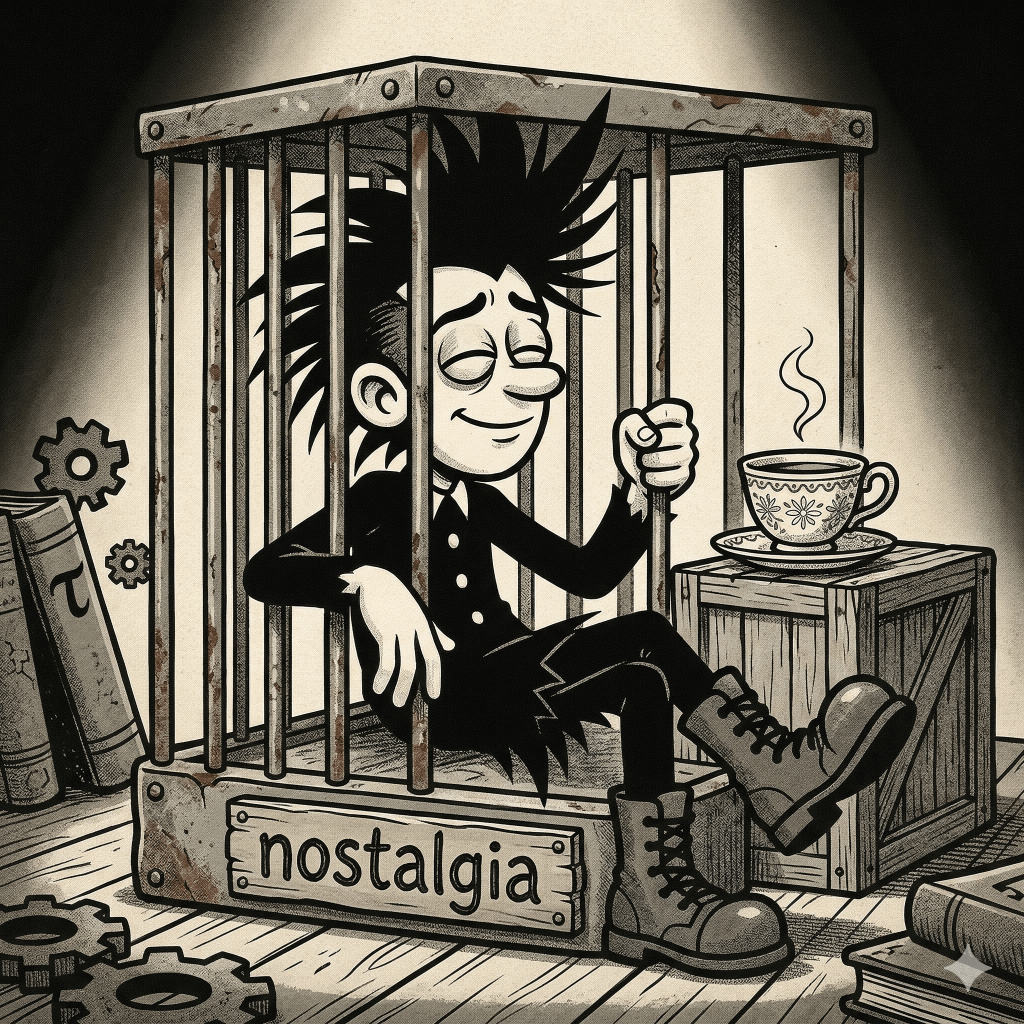
Hauntology is often treated like an aesthetic choice. A fondness for analogue media. A vibe. A fondness for library music and decaying public information films, preferably viewed at a respectful distance.
From the inside, it’s none of these things, which is where the confusion starts.
Hauntology is what it feels like when the future fails to arrive, but its promise remains active. You’re haunted not by the past, but by futures that once seemed plausible and are now inaccessible. They don’t go away. They linger, exerting pressure on the present like unpaid debts you keep meaning to sort out.
This isn’t nostalgia, at least not in the cosy sense people usually mean.
It’s structural. It alters how time behaves. How memory functions. How the present thins under the weight of what should, by now, have followed it.
From this perspective, hauntology isn’t a cultural diagnosis so much as a lived condition.
Which is why it resonates so strongly with experiences of mental ill health, precarity, and stalled lives. It gives language to the dissonance between lived time and official time, which rarely bother to sync.
What interests me isn’t declaring culture haunted, which always feels a bit like stating the obvious. It’s understanding the mechanics of haunting itself. How absence becomes active. How repetition stops feeling neutral. How the future can exert force precisely because it never materialises.
There’s nothing particularly romantic about this. Being haunted is tiring. It narrows possibility. It traps attention in endless rehearsal. But it also reveals something uncomfortable about how time actually works, not as a clean arrow, but as a mess of pressures, loops, and stalled trajectories that refuse to tidy themselves up.
This is the hauntology I’m interested in. Not as branding. Not as mood. But as a description of what happens when time refuses to cooperate.
From the inside, haunting is not metaphorical.
It’s durational.
It accumulates. It stretches moments, corrodes momentum, and makes the present feel provisional, as if it’s waiting for authorisation that never comes. Time doesn’t just fail to move forward. It hesitates, doubles back, and exhausts itself trying to resolve something that no longer has an endpoint.
Recent Comments
 | crabmansmith on Love Death and the Crucial Thr… |
 | Will on Love Death and the Crucial Thr… |
| crabmansmith on Love Death and the Crucial Thr… |
 | Mark S on Is this thing on? |
| Will on Guya – Page 10 |
 Will Vigar
Recent Comments