Haunted When the Minutes Drag:
2. Agoraphobia Is Not a Fear of Space
Agoraphobia is commonly described as a fear of open spaces. This is convenient, memorable, and deeply misleading; sort of like saying a Rubik’s Cube is ‘just a bit of plastic.’ It’s not wrong, but dear god is it wrong.
The problem is not space.
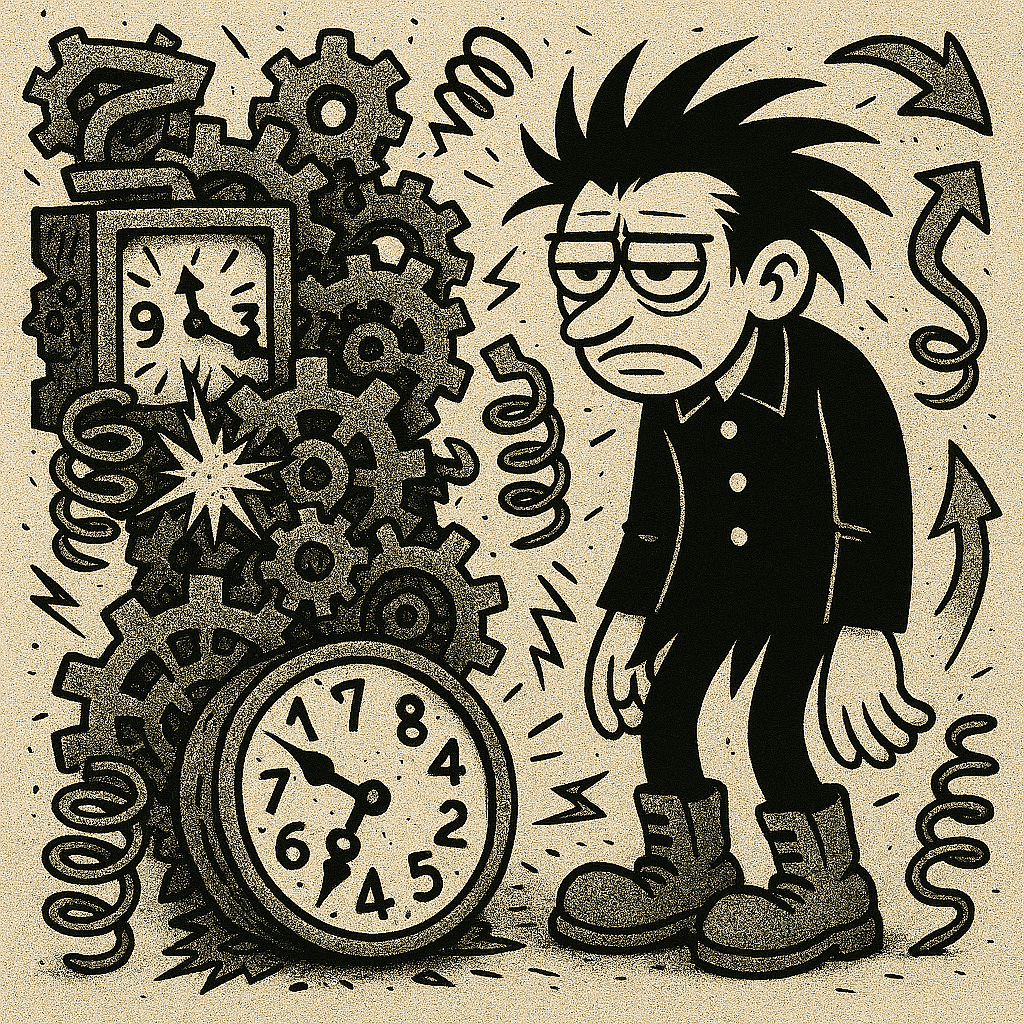
It’s time, more specifically: sequence, thresholds, and duration.
Agoraphobia is what happens when movement through space no longer guarantees movement through time. When leaving does not reliably lead to arriving. When being “out” fails to resolve into being “back”.
This is why reassurance rarely works.
“You can leave whenever you want” assumes that leaving restores temporal order. It doesn’t. It does give you Eagles flashbacks, though.
“It’ll only take a few minutes” presumes that minutes still behave like minutes. They don’t. Time under pressure elongates, collapses, or simply refuses to pass.
What people often call panic is usually the aftershock, not the source. The real disturbance happens earlier when temporal trust erodes. When you can no longer project yourself forward and feel reasonably confident that things will unfold in the correct order.
This also explains why the condition appears maddeningly inconsistent from the outside. A small shop can feel impossible; an empty coastline can feel expansive and safe. The difference is not scale, but legibility. Some spaces allow time to flow. Others trap it.
Sitting with my back to a door in a restaurant, for example, is no good. Seeing the door allows a way forward, a temporal, rather than spatial flow. There is an escape, there is forward movement. I am not stuck in Sapphire and Steel’s eternal diner.
Clinical descriptions struggle here because they prefer behaviour to experience. They ask what is avoided, not what has broken. They measure exposure rather than duration. They assume fear where there is often something closer to temporal vertigo.
I’m not interested in correcting the definition out of pedantry.
I’m interested because misnaming a condition leads to mistreating it. If agoraphobia is understood purely as fear, then confrontation will always be the solution. If it’s understood as temporal dislocation, then pacing, predictability, and thresholds suddenly matter a great deal.
This doesn’t make the condition easier. It does, however, make it more intelligible.
Space gets the blame.
Time does the damage.
Recent Comments
 | crabmansmith on Love Death and the Crucial Thr… |
 | Will on Love Death and the Crucial Thr… |
| crabmansmith on Love Death and the Crucial Thr… |
 | Mark S on Is this thing on? |
| Will on Guya – Page 10 |
 Will Vigar
Recent Comments