Dream Tyne – Travels Around the North East Coast (Part One)
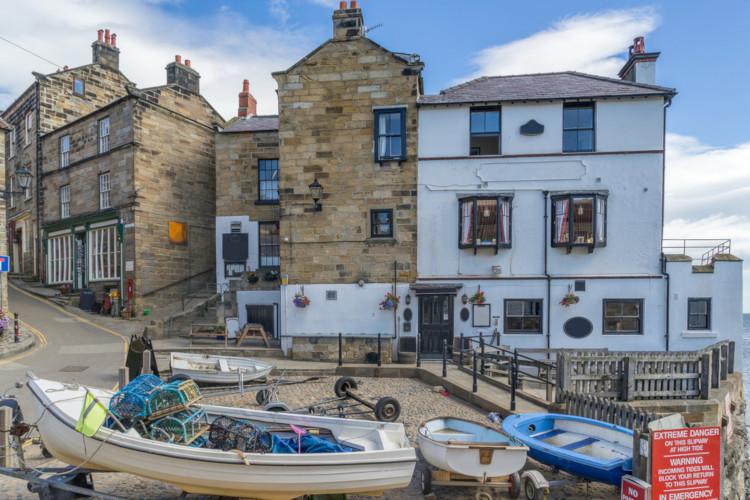
Robin Hood’s Bay 1
I needed to get away. Somewhere quiet, isolated. I wanted to finish drafting my dissertation in a place with no distractions. The problem was that an off-season seaside town may seem like a quiet place with few people, but it’s history and stories are no longer camouflaged by tourist entertainments. There is nothing between you and the landscape, the history, and the sea.
This turned out to be literally true as we stayed in the old Coast Guard building. The ground floor is now a Coast Guard Museum, the central floor a learning and community centre and the attic space had been made into a small but comfortable holiday let. The whole building is owned and maintained by the National Trust. What fascinated me, and what drew me to the flat in the first place was that at high tide, the sea came right up to the building. When the waves crashed, they crashed against the window in the living room and the building was all but surrounded. At High tide, three of the four sides of the building were in the sea.
It felt like home.
We had decided that I would wake early and write for a few hours before breakfast. Post-breakfast we would discover what the area had to offer. So, I would wake at 5am, work for four hours, go to the Coffee Shack for breakfast, climb the unimaginably steep hill to the car park and travel around the coastal area of North Yorkshire and beyond until evening.
On the first morning, I woke at 5am as planned, went into the living room, and saw the sea lapping at the window frame. I sat by the window, looked out over the Jurassic Coast, and felt a moment of intense serenity. At times, the sea seemed almost to stop, and the clouds would be reflected in its perfect mirror. Moments later, a breeze would cause the water to ruffle, and the reflexion would be lost. On the third or fourth stillness, I looked at the clouds in the sea and saw a faint glow. Pinks and lilacs coloured the water. It didn’t quite look like the colours of a sunrise, so I looked up and saw the sky had a beautiful mother-of-pearl veneer. Horizon to horizon, a pearly iridescence dazzled. Fragmented rainbows drifted, merged, and dissipated in a light show to rival the aurora.
What I had seen, I learned much later, was a rare meteorological occurrence, a phenomenon I hadn’t been aware of until seeing it. Nacreous Clouds, sometimes known as Mother of Pearl clouds, are rarely seen as far south as Scotland, so reaching North Yorkshire was a rare event indeed. They only manifest for a few minutes, an hour or two before sunset or at dawn – and then only if the lower stratosphere reaches -78C.
After the colours and cirriform clouds had evaporated in the rising sun, I watched the sea recede and reveal rock, crusted in gravel and seaweed. This was a hard shore, entirely at odds with the delicate, noctilucine display I had witnessed earlier but no less fascinating.
I had been lucky enough to see something that very few people in this town – this country – had seen. I saw this as an omen. Something big was going to happen.
I basked in its memory but wrote nothing.
Ravenscar
My first encounter with Ravenscar was through ‘Hellblazer,’ a comic from the legendary ‘Vertigo’ comics line, published by DC. In it, John Constantine, a sneering, Liverpudlian, maverick occultist, with a propensity to betray his friends while casually sucking on a Silk Cut, has been incarcerated in the Ravenscar Mental Hospital. The institution, seen in silhouette against lightning slashed skies, holds him straitjacketed and screaming. Pleading for mercy to the demons he had summoned but failed to bind. Driven mad by being forced to watch as one by one, his friends were torn apart or lost to insanity, a child named Astra – whom he was attempting to save – was ravaged, possessed and dragged into hell.
At the time, I had no idea that Ravenscar was a real place and assumed it was a UK analogue to ‘Arkham Asylum,’ the high-security hospital for the criminally insane, seen in the Batman comic books. Later, when discussing it with friends, I discovered that a place called Ravenscar existed on the North Yorkshire Coast. I shuddered at the intersection between horror and reality but was intrigued enough to research further.
Robin Hood’s Bay 2
After breakfast, and with the scene now set for the extraordinary, I planned my day, starting with a walk along the shore. At low tide, you get a sense of the primordial. Pitted and pocked, the limestone and shale hold rock pools, too small for the expected abundance of life. Occasionally, a small creature will become trapped and, if lucky enough, freed on the next tide but the pools are small, less than a foot in diameter, and there is nowhere to hide from the scavenging sea birds.
The sea here is relatively shallow meaning that the tide goes out a long way. As you walk towards the horizon, shale gives way to mudstone. The tide continues to retreat but it becomes unwise to follow its shimmering exit. Again, being so shallow, the incoming tide arrives at speed, and it would be easy to become overwhelmed.
Standing on the flat, I thought of H.P. Lovecraft and his short story “Dagon,” about a sailor lost at sea. After a storm he wakes to find his ship in pieces and, curiously, stranded on a stinking mudflat with no other land in sight, no sea, no signs of life just endless mud augmented with dead and rotting fish. The fish he5re are, mostly, too canny to be caught by the tide, and the limestone, shale and mud smells clean, untainted by the occult stench of the Great Old Ones. This comes as a relief, although the image remains.
I turned and looked towards the shore. To the north, I could see Whitby Abbey, to the south, Ravenscar. Both places famous for events that didn’t happen.
David Bowie 1
A few days before the retreat to Robin Hoods Bay, David Bowie released what would turn out to be his final album ‘Blackstar.’ My partner is largely indifferent to popular music but as we raced along the M1 towards the North Yorkshire Coast, the album played, and he recognised the album as being something special.
Since I was able to think with any kind of critical awareness, I have known I was ‘other.’ I didn’t fit in. I didn’t feel part of the world. I was always ‘the weird one’ at school, despite feeling entirely ‘normal.’ At infant’s school, I was aware that I didn’t fit in, I didn’t know why that was, although it’s possible my shape-denying teacher had a lot to do with that. I didn’t have any notion of sexuality or gender or any of those issues at the tender age of eight; back in the 1970s that sort of thing simply wasn’t talked about, but my classmates knew something was… wrong? Different? Other?
I came home from school turned the TV on and slumped on to the sofa. On this particular day, “Lift Off with Ayesha” was on; a sketch show featuring Ayesha Brough and a puppet Owl called “Ollie Beak.” Among the comedy, a musical guest would play a song or two. On this most special of days, David Bowie played “Starman.”
I had never heard anything like it. I had never seen anything like it and more importantly, I had never felt so completely normal. Here was someone who looked as ‘out there’ as I felt inside. Here was someone who understood exactly who I was and how it was to be comfortable with all of those bizarre contradictions of simply being that I felt.
Here was my leper messiah.
Whitby 1
We entered the town via the North Terrace and walked towards the main town, stopping briefly to watch a flock of starlings bathing in a pool in the municipal gardens. We walked a little further and saw the whale bone arch. At the time, I wasn’t sure what it was, but to me, it looked like a giant pair of fangs. I thought this a particularly crass way of celebrating Whitby’s literary history and became quite annoyed.
My partner pointed out the Whitby made most of its money from hunting whales. The ‘fangs’ were, in fact, the jaw bones of a whale. I was pleased that it wasn’t the crass commercialism I had feared, but uncomfortable with celebrating such a heinous industry. The jaw bones are the third set to grace the city, the first (1853) and second (1963) are now in the Whitby Archive Heritage Centre, having suffered from raging wind and salt air. The set currently on display were presented to the city in 2003 by native Alaskan Intuits. Although the bowhead whale was ‘legally killed,’ I had couldn’t help but think that given the current feelings about whale hunting, a replica would have been more appropriate. It would probably be longer lasting, too, ensuring that another whale would not have to be killed in future years.
I recognised my own hypocrisy, being an advocate of not applying today’s mores to past norms but was conflicted.
Still, the view of Whitby Abbey through these giant ‘fangs,’ however crass, made me smile.
I Remember The Sun

Atop the scar in the full
fury of the northern sea
my skin is as a strop
for the gladius wind.

Unlit, the beacon offers
no warmth or comfort
in the dark – oh, the dark - oh dark,
and in the thick of the fret,

I remember the warm
the scent of wild
salvia - crushed underfoot
in the swaddling mountains,

the fragrant scirocco-soaked
victims of youth and long gone
joy. Another turn around the walls
lost in the dulling haar, shivering,

beaten. It's not the people who
are savages here but if we could
shank the wind and rain, and leave
the hail to Constantine,

I might remember the sun.
Ravenscar – A Brief History 1
It is the fifth century. The Roman Empire is in catastrophic decline and the last of the legions stationed at Peak Fort pack up and leave. Its primary function is as a signal station, just one of a long chain that stretches along the east coast. The cliff top site is desolate, wind ravaged, unwanted. In the next nine hundred years, the fort decays and all but disappears. The savagery of the Roman invaders is not forgotten and the space they occupied is treated with suspicion.
In the next one hundred years, a small cluster of farm and outbuildings built around the southern edge of the site expands and forms the village of Staintondale. One farmer, John Beswick, outgrows the village and in 1540 begins to build Peak Farm on the site, breaking one thousand years of suspicion.
The farm persists for 240 years or so, passing father to son until the land is bought by William Childs. Childs, a captain in the King’s Regiment of Light Dragoons, becomes the owner of the Peak Alum Works, to the north of Peak Farm. With alum being essential to the fixing of dyes, cottons mills and fabrics manufacturers provide Childs with a steady and plentiful income stream. The profits made by the works pay for the building of an extravagant family home for Childs. During the expansion of the farmhouse, a foundation stone for the Roman Fort is found in the cellar. The stone is later gifted to the Whitby Museum.
Child’s daughter, Ann, is bequeathed the house on his death in 1829, and with her husband, Dr Francis Willis, transforms the hall into a sanatorium for the rich and famous. Dukes, Earls, Barons and Baronesses from across Europe flock to Peak Hall to take in the sea air and be cured of the burdens and ailments of the Upper Classes. The Queen of Portugal spends time recuperating and King George III visits regularly to recover from his bouts of ‘madness’ – later suggested to be either bipolar disorder or porphyria, a disease of the liver that displays symptoms of confusion, fever, high blood pressure, seizures, vomiting…
The extraordinary wealth that this parade of nobility generates is thrown away by the Reverend Doctor Richard Willis, Ann’s son. Despite his titles and piety, Willis squanders the money, addicted to louse racing. This escalates to betting on horse racing – mostly at Doncaster Racecourse. The stakes are higher, the losses greater. He embarks on a set of expensive renovations that include a hanging terrace, entirely unnecessary battlements, and further expansions to the hall, adding to the ever-mounting debt. Curiously, he also builds a small ‘cave’ into the cliff wall below the hall, just the right size to allow signals to be sent either to Robin Hoods Bay, where tales of smugglers are common, or out to sea. Although there is no solid evidence that the Reverend Doctor participated in smuggling, the positioning and usefulness of the artificial cave could lead to some damning assumptions being made.
The reputation and respectability built up by William and Ann is quickly destroyed by Richard and to pay off the crippling debts he has accrued, Peak Hall is sold to William Hammond in 1845. Richard then cements his reputation as a man of ill-repute by offering quack remedies and a hypnotic cure for insomnia for one guinea at time, still trading on the reputation his mother and father has developed. Eventually, after imprisonment for fraud, he returns to the church and takes a ministry on the Isle of Sheppey.
Hammond rids Peak Hall of its bad reputation restructuring and renaming the building ‘Raven Hall.’ He expands the small village that had built up around it by building a windmill, a village church and other amenities. He was also a director of a building project tasked with creating a railway line between Scarborough and Whitby, a Ravenscar Railway station is built. As keen as he is for the railway project to succeed, he does not want the track to bisect his three hundred acres of land. Instead, he pays for a tunnel that allows the trains to pass beneath his land. Tragically, he never sees the line completed, dying three months before the end of the project. The station services the rapidly growing village for around 80 years, but not without problems. The slight incline proved problematic from the available steam trains and resulted in delays as it huffed up a slope that even the most infirm person could manage.
His daughters inherit the site after the death of their mother, but unwilling to take control of the lands, sell it to the Peak Estate Company for development.
Recent Comments
 | crabmansmith on Love Death and the Crucial Thr… |
 | Will on Love Death and the Crucial Thr… |
| crabmansmith on Love Death and the Crucial Thr… |
 | Mark S on Is this thing on? |
| Will on Guya – Page 10 |
 Will Vigar
Recent Comments