The Magic TV
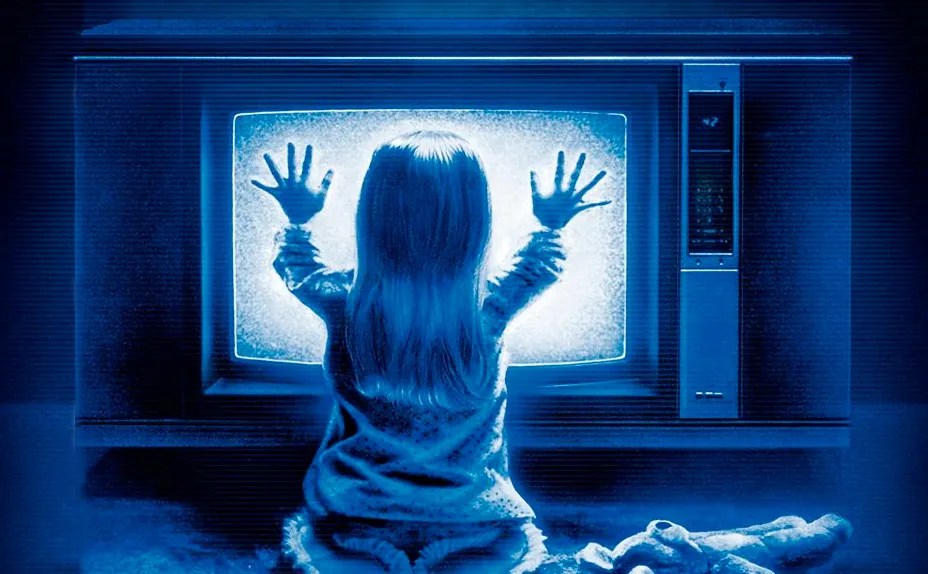
For the first time, I have a small black and white TV in my room—a Christmas present. I was able to shut myself away and watch what I wanted; the loss of colour far outweighed by the need for sullen solitude.
I would make sound collages using the TV, a cassette player, shortwave radio transmissions, sound effect records, and an old reel-to-reel tape recorder. Sometimes, I would create a rhythm using looped tapes of white noise from TV ‘snow.’ Occasionally, these would morph into sons, but that wasn’t why I made these sound journeys.
On more than one occasion, I fell asleep while watching the TV, only to be woken by the close-down static. I would stare at the blizzard fury of dead transmissions, and if I stared just right, I could make out patterns, shapes, symbols from the visual blare. The screen showed random noise, but I was able to pick out non-random images. I could change them at will and turn circles into stars, stars in sine waves, sine waves into triangles, and watch them spin across the screen.
This was no secret message, nor was it an attempt at contact by the dead or by aliens. This was my imagination forcing order onto chaos. They meant nothing more to me than a game.
I made the mistake of assuming everyone had experienced this phenomenon. On discussion with school friends, I was given strange looks and ultimately a wide berth. One of my closest friends dropped by after school to see if I was okay. The ridicule had been quite severe and had upset me greatly.
His father was a psychiatrist. I think that rubbed off on him a little. He asked if I heard voices, received messages, or instructions from the TV I sighed and said no. I think that was as far as his knowledge of psychiatry went, and he was unable to continue any further line of inquiry.
I suggested to my concerned friend that he have a go and pointed out that we may stare at the same screen, but – if it worked for him at all – he might see something different. He agreed, curiosity getting the better of him.
I detuned the TV to an empty channel, what with it being a good six hours before close-down and stared through the screen in the same way that I would stare at Magic Eye Pictures six or seven years later. There was no other sound than the white noise for several minutes and then:
‘Oh, my God!’
‘What is it?’ I asked.
‘Square wheels!’ he gasped.
He described a line of squares, spinning, arranged like the wheels of a train and turning on unseen axles.
He held more cool kudos than I did at school, and the following morning, the class was abuzz with his stories of my magic TV and the square wheels.
I had a procession of visitors in the following days, all of whom wanted to stare into the magic TV that showed pictures even when it wasn’t tuned in. In less than a week, the random patterns on my TV screen that I focused my imagination on held a supernatural, mythic quality. The space between channels became enchanted space.
I had a mystic television.
People claimed to see all sorts of fantastic visions. Full-colour, singing and dancing extravaganzas that grew more lavish the more people looked.
I watched, fascinated, wondering if there was something more to this phenomenon than overactive imaginations, hysteria, and a need to belong; to experience something magical. I thought of the ‘ghost’ in the needlework room and decided not.
As with the ghost in the needlework room, when the story reached the adult contingent, the spell that these events cast was broken – destroyed in the light of adult rationality and, perhaps, fear.
The phantoms, both in the TV and the needlework room were not viewed as ‘real’ and perhaps ‘dangerous’ by the adults. A product of overactive imagination, they said. That, I was quick to point out, was my point entirely.
The fascination was in the creation of these visions by the power of imagination alone. If I was upset at anything, it was that such rampant creativity was being quashed. This was a situation I never got used to; from the lunar module incident to the later event of being thrown out of Art School for being ‘too creative’ and displaying ‘the wrong kind of creativity.’
I saw little to distinguish the two phenomena, except that one was technological and ‘new’ and the other was far more primal and ‘old,’ less immediate and further away from modern understanding, occulted (literally and figuratively) by temporal distance.
Television could be said to produce ‘manufactured’ phantoms with the captured light of the past. They demand a place in the present and are a technological dream made flesh.
‘Dreams,’ as TC Lethbridge claims, ‘are respectable. Ghosts are not… They both belong to a different level of awareness from the one normally used.’ (Lethbridge, 1982)
The facial recognition aspect of pareidolia may also play a part in another method of survival. If a child is unable to recognise its parent, that is, if pareidolia fails, it is likely not to receive as much love and care as a child that demonstratively recognises its progenitors. Love and affection are required for healthy growth and so when pareidolia fails, so will the healthy upbringing of the child.
In his book How We Believe (Shermer, 2003), Michael Shermer argues the human brain has evolved to be a pattern recognition machine. The patterns themselves are real but often subjective. The interpretations of these patterns are sometimes based on correctly perceived information and sometimes an attempt at imposing meaning on chance manifestations.
The reason this ability has evolved is as an aid to survival. The recognition of patterns gives us valuable environmental information that allows us to make predictions about our current situation. It is a vital resource in our ability to learn.
Shermer asks us to consider the following scenarios:
1) The false-positive: You hear a loud noise in the bushes. You assume it is a predator and run away. It was not a predator, but a powerful wind gust. Your cost for being incorrect is a little extra energy expenditure and false assumption.
2) The False-negative: You hear a loud noise in the bushes, and you assume it is the wind. It is a hungry predator. Your cost for being wrong is your life.’ (Shermer, 2003)
The need for this kind of pattern recognition has changed. Our modern lives are rarely concerned with predatory animals in bushes, but we still see patterns everywhere. False positives and false negatives now have vastly different consequences for us.
Shermer alerts us to these consequences calling them ‘pattern recognition errors.’ Such errors include such phenomena as seeing Jesus on a Dorito, seeing faces on the surface of Mars, ‘The Curse of Strictly,’ the vast majority of conspiracy theories and ley lines.
I have to wonder whether this biological, evolutionary need to see patterns is in a state of flux. Its use as a survival technique is no longer useful in the way it once was and through this need to find patterns, we’re applying this embedded ability to inappropriate situations.
Having evolved to see faces in the unfamiliar as a survival technique, we find ourselves having gifted with what is – for the most part – an obsolete ability. In seeing things that aren’t there, we are programmed to be haunted; we have programmed ourselves through evolution, to be haunted.
The concept of pareidolia is utilised in a number of vastly different ways, from seeing Mother Theresa in a cinnamon bun (or Elvis, Jesus, Mary or Harry Styles on a nacho chip) to UFOs hidden in cloud structures and even the psychological tool the ‘Rorschach inkblot tests.’ In each case, one’s innermost thoughts or desires, one’s religious beliefs or one’s psychoses are projected onto the object, and an image reveals itself. Pareidolia may indicate a truth, but it is more likely to confuse than confirm.
Given that a ten-year-old toasted cheese sandwich that supposedly featured the face of the Virgin Mary recently sold for £22,000, there may be an argument that pareidolia has become something of a money spinner.
Recent Comments
 | crabmansmith on Love Death and the Crucial Thr… |
 | Will on Love Death and the Crucial Thr… |
| crabmansmith on Love Death and the Crucial Thr… |
 | Mark S on Is this thing on? |
| Will on Guya – Page 10 |
 Will Vigar
Recent Comments