Firefrost and Fundindelve – Travels Around Alderley Edge (Part Two)
iii -The Wild Magic
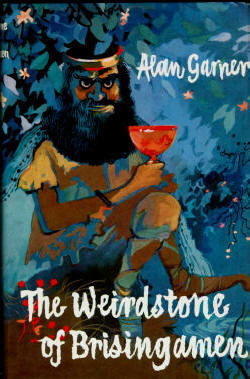
Alderley Edge, or at least my Alderley Edge, exists only in my mind and there is now little correlation between the reality and fantasy Edges. Perhaps that is the point. Despite being birthed at the beginning of the Mesozoic era, The Edge is an ephemeral place. It is solid – as solid as sandstone is – but it absorbs stories, revealing them to those who search for the ‘wild magic’ of the place. This is the essence of Deep Topography; the recovery of the past to affect the present and illuminate the path to the future.
In the first sequel, The Moon of Gomrath, Susan is overwhelmed by the wild magic. She is transformed – we’re not sure what this transformation is in any real sense as Garner’s writing is awash with riddle and conundrum – most perplexingly in the multi-layered second sequel ‘Boneland’. It may be a transformation into a magical being, becoming one of the mythical ‘Seven Sisters’ and travelling to the Pleiades to fulfil an unseen destiny. It may be a metaphor for the onset of womanhood. She may simply have died. Nothing is certain. Boneland – written and set fifty years later – does little to confirm her fate.
But that’s okay.
The story is not about Susan, or Colin, or Cadellin. It is not even about the titular Weirdstone at all. They are merely bit players in the story of The Edge. How do we know this? Quite simply, the characters are secondary to the locations. Garner himself, on numerous occasions, has noted that Colin and Susan are little more than cyphers. They have enough personality to facilitate the action but lack any real depth.
Throughout the trilogy, The Edge reveals itself to be the subject of the books. The lack of depth in the human, Elvish or Dwarven characters is irrelevant as they are not the story’s focus; they are phantoms that haunt The Edge – fleeting memories recalled by a Triassic giant. A hauntological repetition – the dreams of ore and aether.
In Boneland, Colin’s fate is revealed. With the disappearance of Cadellin, whose presence in this book is little more than thunderclaps and anger, he has taken over the custodianship of The Edge. He becomes its conscience, its avatar. He remembers nothing of the adventures he had with his sister, just that she was lost. He is a brilliant, if erratic, astrophysicist that works in Jodrell Bank, visible from the village and, not surprisingly, he has a special interest in The Pleiades. He, like the radio-telescopes he works with, is constantly searching. He may also be seen as an avatar for science.
Time and space behave in accordance with the laws of physics, not in the way in which we would prefer to perceive them. Ignoring this disparity and actively working against it, Colin loses his sister and sanity. Or at least, according to the ‘rational’ world, his sanity is in question. But Colin has moved into mythic time, or perhaps GraftonTanner’s ‘nostalgia bubble dimension’* and operates at a single location at all times. According to Deleuze and Guatarri, this ‘compression of time’ into a single space is better known as schizophrenia, describing it as a collapse of temporal order. They go further in saying that temporal order – times arrow – collapses to such an extent that all time is perceived simultaneously. For Colin in Boneland,‘ schizophrenic’ is how the world sees him, rather than an avatar of Mythic Time.
There is an adage that states a Shaman is “one who walks between two worlds“ Colin’s fate is to walk between the worlds of wild magic and cool, calm science, perhaps even to reconcile them.
Just as in Garner’s novel Red Shift – which sees a relic lost and found through time by the narrators of the intertwining stories – Colin discovers a stone-age artefact. This links him to a Shaman, a previous avatar of The Edge from a time long before Cadellin; from the age of the wild magic that has taken his sister. The Edge is revealing its history to Colin, showing him his place within its story; suggesting that Cadellin and the High Magic he performs has no place where wild things are hidden. It is a double-edged sword that gives him purpose but also reveals that his presence on The Edge is fleeting and that the story he is currently engaged in has played out countless times before. It is a reminder of his inevitable mortality.
But there is uncertainty in the inevitable and as this incarnation of the story unfolds, previously friendly characters spit their rage at him, and previously villainous characters coax him out of his mania to live a more fulfilling life. The Edge has repositioned and rewritten the characters to ensure its avatar is capable of the job entrusted to him. It also suggests that The Morrigan, Grimnir and the Morthbrood were really the heroes of the previous books, trying to dismantle the bounds that caged and commodified the wild magic.
iv – Monument
My time at Alderley Edge, both the village and the outcrop, amounts to a little less than four days. That includes time spent in the hotel, not sleeping, as the source of the Old Evil in the Moon of Gomrath was imprisoned in a capped well that I could see from my hotel room. I thought it might be fun to stay at the hotel named in the book – The De Trafford Arms – but that innocent looking drainage cover rattled me. I could almost feel the black, smoke-like appearance of the Brollachan with its flaming red eyes staring at me through time, page and access cover.
The time spent in my imagined Alderley Edge runs into years – not just reading time, but the daydreams, the night terrors and the wishing. I feel more comfortable in my Alderley knowing that the indifference of the Edge is tempered by human softness… and having an ‘off switch’ for when being ‘relentlessly pursued by outlandish creatures’ becomes too much of a burden.
Despite being static and largely unchanged, except of course for the tragic erosion of the Wizhard carving and – in the light of Boneland – its arrogant invitation, it bristles with life and change. It will outlive its current bound indignity and, laughing, will tell stories to its future avatars of the time when ‘men-folk’ tried to constrain it.
A monument to life, death and magic, Alderley Edge is a remarkable entity that I feel both married to and divorced from.
It is a place that haunts me.
A place that haunts itself.
v.
On Visiting Alderley Edge in the of Finding a Wizhard

I wanted to follow in their footsteps -
inhaling the clean filth of leaf mould.
Terror and adrenalin giving scent

to the enemy; to be “relentlessly
pursued by outlandish creatures.”

Then, when all hope was lost, to hear
the gates roar as they opened
to a world of pale blue flame and milk

white mares but I’m lost
on the Wizards Path – tricked
by svart alfar- and trying to reconcile

the convergent memories
of book and prior pilgrimage.

I remember my last communion
at the well as sodden and solemn
in a hollow - the focus of a grove.

Opaque sun percolating through
fat drizzle – protected by the trees
– a wall of stone behind, funnelling

us into adventure. But the claustrophobic
bole of my misremembered landscape,

is an open outcrop, exposed to the skies,
battered by wind. Its naked wildness
emasculated by plastic safety fencing;

an unwelcome barrier between self
and prospect. The ghost of a wizard,
my Wizard, once bold, clean cuts in the rock,

have eroded; neglected. His stilted welcome –
“Drink of this and take thy fill,
for the water falls by the Wizhard's will”

- all but gone; sandstone grit, weather ground
from the face and words of a childhood
lost, chases along runnels and dissolve into legend.
NOTE * – Grafton Tanner’s books offer a marvellous insight into hauntology and were used extensively to inform my PhD. In particular, ‘The Hours Have Lost Their Clock’ and ‘ The Circle of the Snake.’ Thoroughly recommended.
Recent Comments
 | crabmansmith on Love Death and the Crucial Thr… |
 | Will on Love Death and the Crucial Thr… |
| crabmansmith on Love Death and the Crucial Thr… |
 | Mark S on Is this thing on? |
| Will on Guya – Page 10 |
 Will Vigar
Recent Comments