Firefrost and Fundindelve – Travels around Alderley Edge (Part One)
i.
Firefrost and Fundindelve
The Weirdstone of Brisingamen, Alan Garner’s 1960 novel has had me entirely in thrall for almost 50 years. It is a timeless tale of good versus evil, light versus dark, and the main character is not Colin, Susan, or Cadellin Silverbrow. The main character is the sandstone escarpment known as Alderley Edge on, or under, where much of the story takes place. Despite its geological stillness, it is a fickle place. A playground one moment and a trap the next. A carefree space of dappled sunlight and a mist-shrouded claustrophobic prison cell. Of wide-eyed innocence and gladiatorial terror. It holds both the darkness of the Morthbrood, and the light of the Fundindelve.
It sits, watches, manipulates as if a living, thinking intelligence. Garner notes this in his book of essays, ‘The Voice That Thunders’, by suggesting that The Edge ‘ …is physically and emotionally dangerous. No one born to The Edge questions that, and we showed it proper respect.’
In Garner’s works, there is a feeling that Alderley Edge is an agent of collective memory, a repository for local history. Its job is to observe, teach and heal. The events of the Weirdstone may be new to Colin, Susan, Bess and Gowther, but to Cadellin Silverbrow – possibly an avatar of The Edge – it is not the first time these events have taken place. Long is the battle between darkness and light, and it is a tale etched into the sandstone as scars, songs, and stories.
My first encounter with the book was in the final year of infant’s school. I especially looked forward to Friday afternoons mostly because the Saintly Mr Bessant had decreed that they should be spent doing art, singing, and ending the week with a story.
After several engaging but not overly exciting books, Mr Bessant chose The Weirdstone of Brisingamen to be one of those stories. In retrospect, it was probably a little too old for us, but he edited out some of the more difficult-to-stomach passages, as Emma found out when she brought her own copy to read along with him. She kept complaining that she couldn’t keep up with him because he was leaving things out.
We were about two-thirds of the way through the book when the unthinkable happened, and my parents informed me that we were leaving Bedford for Tunbridge Wells. My immediate thought was that I was going to miss the end of the book! It wasn’t that I’d have to say goodbye to my friends, go somewhere unfamiliar or start a new school. I was going to miss the end of the book! I had to know what I had to know if Grimnir and The Morrigan would be vanquished and that Colin, Susan, Cadellin, Fenodyree and Durathor survived!
On my last Friday at Shortstown Infants’ School, we still had around four chapters to read. We didn’t make the move to the new house until Monday lunchtime, so I begged Mr Bessant to loan me the book, promising to return it before we left. The Saintly Mr Bessant agreed, and I was able to finish the book over a hectic and fraught weekend of packing, returning it, as promised.
The Weirdstone of Brisingamen is the book I have read the more times than any other. I still read it at least once a year, starting on April 12th. A birthday treat, established in 1972.
Surprisingly, it had never occurred to me to visit Alderley Edge. I knew the place was real, unlike Milbury, the fantasy version of Avebury in HTV’s Children of the Stones, a TV show that had almost as profound an effect on me as the Weirdstone and discussed in [A Psalm of Stone], but Alderley Edge always seemed ‘other’ – a magickal place available only to those with a connexion or history to the place.
I left home and moved to Sheffield. My friend Mark came to visit and, despite the myriad pleasures Sheffield had to offer, suggested a road trip to Alderley Edge. He had read the book on my recommendation and was intrigued as to how much of the landscape was real.
On reaching The Edge, we were agog that except for The Iron Gates – the physical gates, not the rock they are named after – and The Fundindelve behind them, every location mentioned was real. We couldn’t be certain of The Earldelving – possibly the most terrifying and claustrophobic chapter ever written – but we found a dip in the land where the exit was supposed to be. It did not take much imagination to believe that Colin, Susan, Fenodyree and Durathor were still struggling to free themselves from the collapsed tunnel, the full force of The Edge pressing down on them.
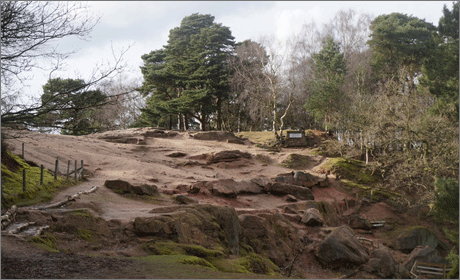
We found the entrance to the underground ‘Cave of the Svartmoot,’ in reality – or at least in this reality – it is called ‘Engine Vein’ and located in the West Mine. We decided to follow Gowther Mossack’s advice to the children and not risk losing ourselves underground in the abandoned them. We walked by the Seven Firs, gazed in wonder at the riven Goldenstone, drank from The Wizhard’s Well (not recommended) and looked over the ‘flat as a poncake’ levels of Cheshire from Stormy Point. Each location was tangible, beautiful, real.
We had lunch at The Wizard, a pub mentioned in the book and named after the legend. We then went to look for the home of Shapeshifter, The Morrigan, Selina Place – a building named St Mary’s Clyffe in the book and on the other side of Alderley Village to The Edge. We could not find it and assumed that it was another fantasy location, thinking no more of it.
The difference between The Edge and Milbury – both hugely influential on my developing mind – is that with Milbury, the fantastic was overlaid onto an existing space and then stripped out again once the cameras had gone. A temporary phantasm. The location of the story, despite being based on a real place, existed outside of ‘reality’. It was ‘artificial.’ At Alderley Edge, the legends of the Farmer meeting the Wizard with the pure white horses – or rather ‘milk white mares’ – go back for generations, with the earliest written version of the story dating back to the early 1800s.
These legends and stories that are utilised in The Weirdstone are rooted in the landscape and in the collective memory rather than simply dropped on top for the duration of the storytelling. Children of the Stones roots the story to the place by using genuine Avebury history but then fudges the setting by renaming it and ‘enhancing’ an already magickal space with additional polystyrene and fibreglass ‘stones’, some adorned with sinister carvings. Perhaps a bigger feeling of unreality and liminality may have been experienced had the name change not occurred. The inclusion of the false stones, in retrospect, made the real place seem ‘lesser’. Perhaps honesty, or integrity, makes the fantastic more ‘phantasmagorical,’ as Matthew Brake, the lead character in Children of the Stones, would have said.
Re-reading the book – on returning home – was an entirely new and vivid experience. The story had a whole new life and corporeality. The places I had imagined as a seven-year-old boy and had perpetuated and embellished on each reading suddenly seemed wholly inadequate.
ii – St Mary‘s Clyffe
Thirty-Five years after my first visit, I made my long-promised return. In the intervening years, the town of Alderley Edge has hugely expanded. Rather than being a quaint English Village, its proximity to Manchester has transformed it into the playground of the ultra-rich, with soap stars and footballers making up a substantial portion of the population. As a result, a gigantic Waitrose has taken over from the independent traders, and the main street is now a slew of café bars, high-end restaurants, and haute couture. The rural element has been almost completely displaced.
It has lost its soul to the ‘Real Housewives of Cheshire,’ but from Alan Garner’s perspective, despite his obvious love for the location and rather pleasingly, he notes ‘that Alderley Edge has always been a fake. Its real name is Chorley, which didn’t suit the textile barons of Manchester who came with the advent of the railway in 1841. It’s a place that has always attracted new money. The difference in the 19th century was that some of the commercial families were philanthropic and cultured.’
Of The Edge itself, it has been taken over by The National Trust, and rather than being a free and wild space, it has been segmented into paths and colour-coded walks. I couldn’t imagine Colin and Susan running from the horrors of the Morthbrood along these prescribed routes. I thought of Guy Debord, railing against the Haussmanisation of Paris and creating the derive in an act of protest to the city’s ‘compartmentalisation.’ For the first time, I really understood his ire. The existence of these paths diminishes the impact of the book, and rather than being a wild space where supernatural adventures take place, it has been made into a commodity. Arrows mark the way around The Edge, unforgivably showing the evil Svarts how and where to find the fleeing children.
The Edge is still beautiful, but its wildness has been tamed; domesticated. Its timelessness, ‘a place that stopped and melted time,’ now bound by a garish orange three-strand polypropylene rope; the natural yellows, greens and ochres unfettered, but nervous.
On this visit, after hearing Garner speak of the building as a real one, a more concerted effort was made to find St. Mary’s Clyffe, the aforementioned home of The Morrigan. All I had to go on was a bare description from the book and a tiny line drawing in its frontispiece. Luckily, the roof and gable patterns are very distinctive, and after several hours of searching, there could be no doubt that the building in front of us was the place where The Morrigan and Grimnir – the treacherous lackeys of Nastrond – had sought to extinguish the light of the Firefrost. Even the wall that blocked the lower levels of the house in the picture was present, inscribed onto a rude map of the local area. Now called ‘The Hollies’, on seeing it, I still got chills wondering if columns of writing smoke hid behind heavy, scarlet, velvet curtains; wondering if, like the Marsten House in Stephen King’s novel ‘Salem’s Lot,’ evil attracts evil; wondering what really lay behind those tiny Norman windows; wondering if the excruciating blandness of the new name was masking something unspeakable.
What is most extraordinary, however, is that my memory of the real, physical village and its surroundings, so vividly brought to life from my previous visit, has been slowly eroded and replaced by the Alderley Edge of my imagination, much as the carving of the ‘wizhard’ above the well has eroded.
I could no longer be certain of either landscape.
Recent Comments
 | crabmansmith on Love Death and the Crucial Thr… |
 | Will on Love Death and the Crucial Thr… |
| crabmansmith on Love Death and the Crucial Thr… |
 | Mark S on Is this thing on? |
| Will on Guya – Page 10 |
 Will Vigar
Recent Comments